
Perfectionism and procrastination can leave you working hard around a task without actually moving it forward. You collect more examples, rewrite the opening, or wait for a clear afternoon. The task matters to you, but starting feels like agreeing to produce something flawless.
A useful first move is to make the next action smaller and the finishing standard clearer. Choose one ordinary task, define what it needs to accomplish, and give yourself permission to make a rough first version. You can improve a draft; you cannot revise a task that exists only in your head.
This guide explains the connection, offers seven practical steps, and includes examples and a worksheet you can copy. The exercises are suggestions for everyday tasks, not a diagnosis or a promise that every difficulty with starting has the same cause.
How perfectionism and procrastination connect
The Centre for Clinical Interventions explains that some people delay tasks because they fear they cannot complete them perfectly. Its perfectionism resources distinguish healthy standards from rigid, demanding standards that carry a personal cost. Caring about your work is not the problem by itself. The difficulty comes when the standard makes useful action feel unacceptable.
Imagine needing to send a short project update. You believe it must anticipate every possible question. You spend half an hour rearranging the first paragraph, then decide to send it tomorrow. Delaying removes the immediate pressure, but the update still needs sending. By tomorrow, there is less time and more to explain.
That is one way perfectionism and procrastination can reinforce each other: a demanding rule makes starting uncomfortable, avoidance postpones that discomfort, and the unfinished task creates fresh pressure. This is an illustration, not a test that proves why you procrastinate.
A practical question is: “What am I requiring of this task before I will let myself do it?” The answer may reveal a rule you can adjust, such as needing complete certainty, universal approval, or an uninterrupted block of time.
Is perfectionism the reason you are putting this off?
Look at one recent example rather than labeling your whole personality. What did you intend to do, what did you do instead, and what thought appeared just before you postponed it? Specific observations give you something you can change.
- You keep researching after you already have enough information for the next step.
- You treat a rough draft as if it were the final submission.
- You avoid asking a question because you think you should already know the answer.
- You repeatedly check ordinary work without finding meaningful errors.
- You would rather miss a small opportunity than risk doing it imperfectly.
These patterns can suggest that high expectations are getting in the way. They do not mean all delay comes from perfectionism. Unclear instructions, competing priorities, exhaustion, missing resources, and a task that is genuinely too large also deserve attention.
If you cannot start because you lack access to a file, the next action is to request access. If the workload cannot fit into your available hours, a smaller first step will not resolve the capacity problem. Discuss scope, support, or timing instead of treating an impossible workload as a personal failure.
If you are still comparing possible approaches rather than choosing one, our guide to analysis paralysis focuses on that decision stage. Here, the emphasis is on getting a chosen task started and finished.
7 steps for perfectionism and procrastination
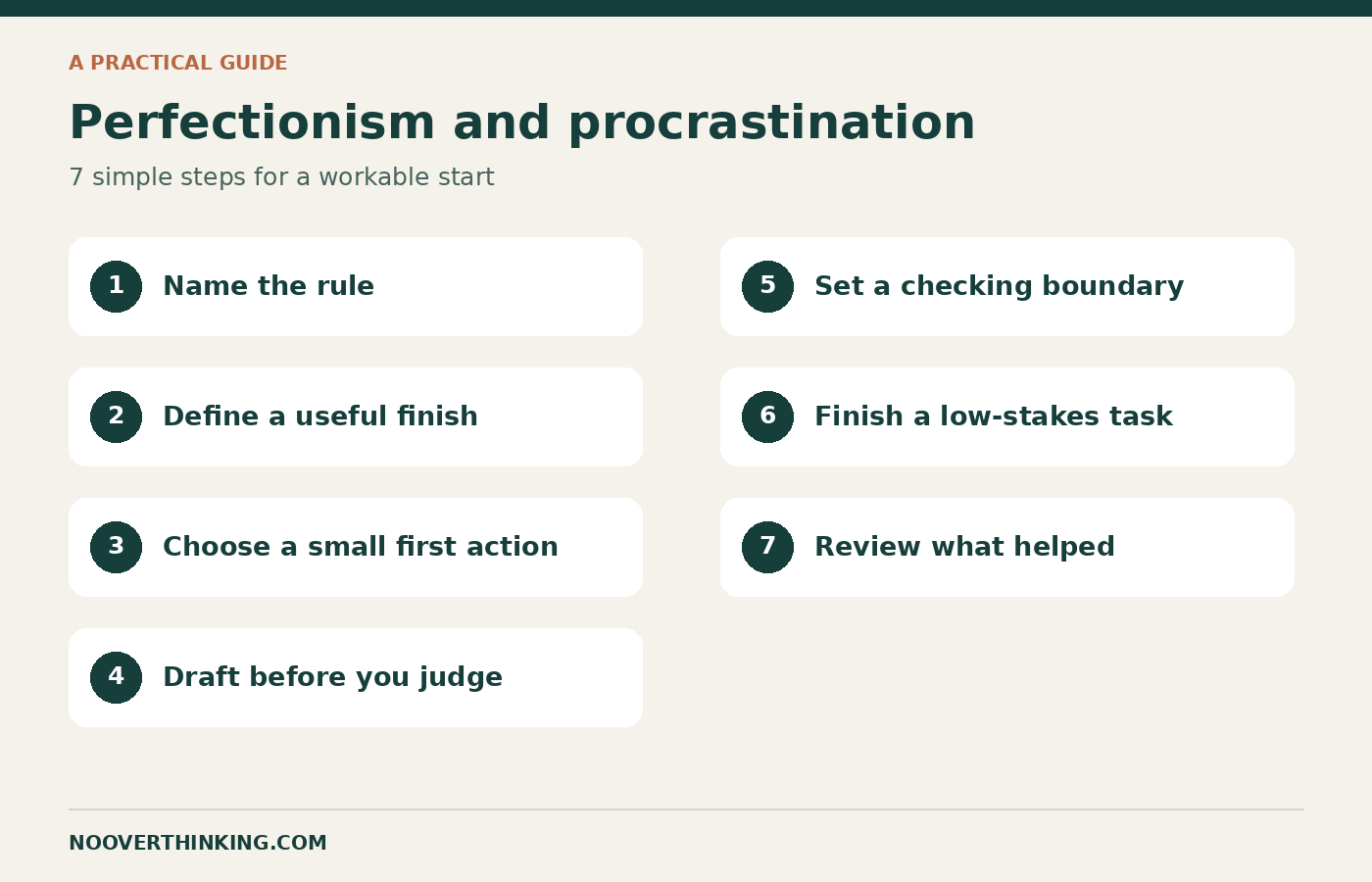
Try these steps on a low-stakes task first. A routine email, a household plan, or a private draft gives you room to practice. Keep required professional checks, factual accuracy, and safety standards in place. The aim is to remove unnecessary obstacles, not essential care.
1. Name the rule that makes starting difficult
Write the sentence your mind is using as an entry requirement. Be concrete: “I cannot share this until nobody could criticize it” is more useful than “I am bad at getting things done.” It identifies a standard that no ordinary piece of work can reliably meet.
Now write a workable alternative. For example: “This update needs to give the team the current status, one risk, and the next action.” The second rule does not require confidence or applause. It tells you what the task is for.
With perfectionism and procrastination, arguing that everything will turn out well can become another delay. You do not have to predict a perfect result. You need a fair rule for what you will do next, including how you will handle a reasonable correction if one is needed.
2. Define a useful finish before you begin
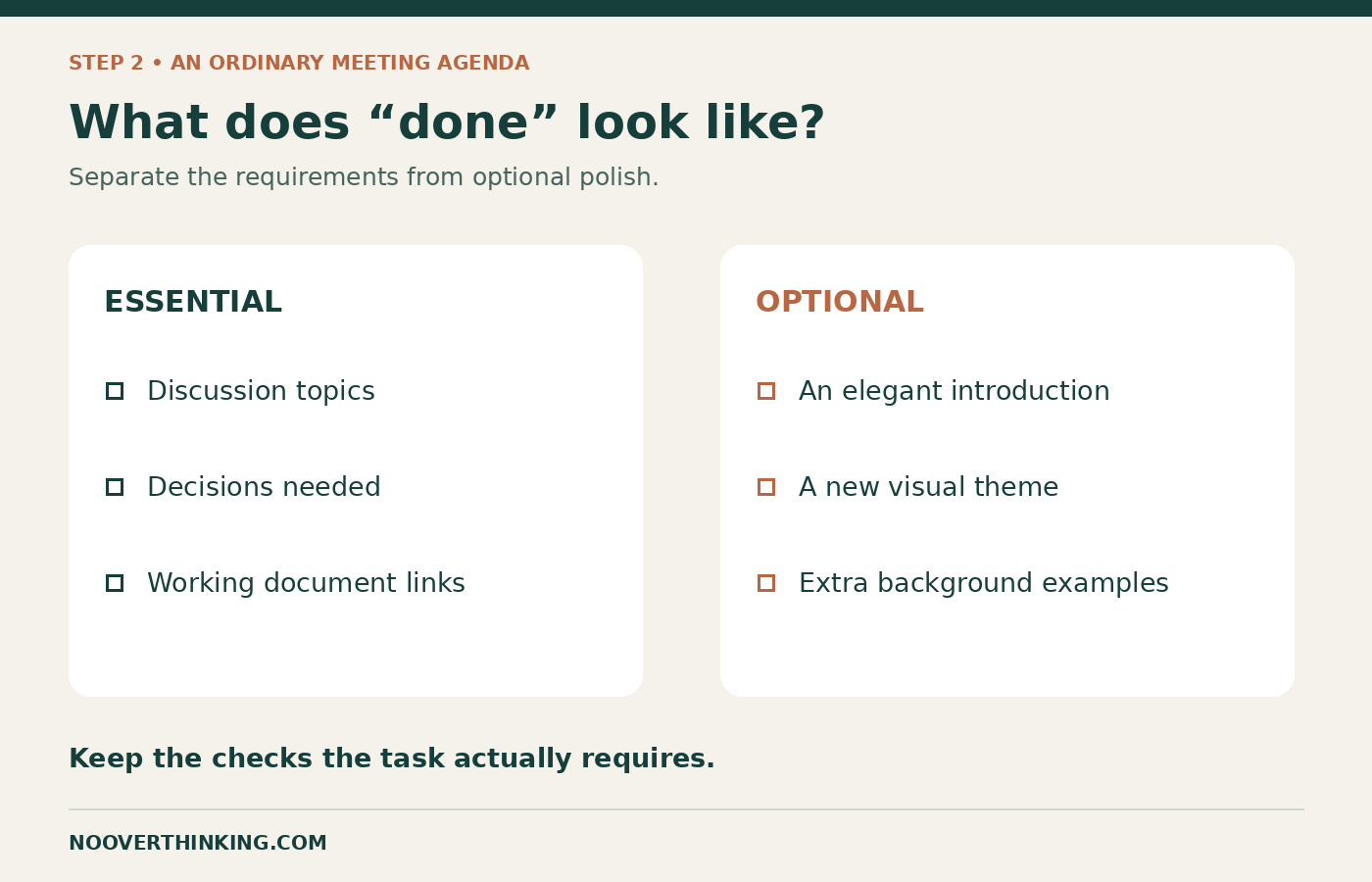
Decide what “done” means in observable terms. For a meeting agenda, that might be three discussion items, a decision needed for each, and a link to the relevant document. Font choices and a beautifully phrased introduction may have little bearing on whether the agenda works.
Separate the essentials from optional improvements. Essentials might include correct names, accurate dates, and a clear request. Optional improvements might include another example, a more elegant layout, or a second way of explaining the same point. Do the essentials first.
If someone else will assess the work, check their actual requirements. Ask, “Do you need a brief outline or a finished proposal at this stage?” A short clarification can prevent hours spent meeting an imaginary standard. Record the answer so you do not repeatedly reopen the same question.
3. Make the first action small enough to do now
Replace a project label with a physical action. “Work on the presentation” is vague. “Open the document and write the three questions the presentation should answer” tells you exactly where to begin. The first action should leave behind something you can see.
The NHS guide to tackling your to-do list suggests trying an activity for five minutes and then seeing how you feel. Use that as a short starting period, not a requirement to finish the entire task. Continuing is an option, not a trap hidden in the timer.
At the end, either continue for a realistic period or leave a specific next action. “Add the delivery date to paragraph two” is easier to return to than “finish later.” For perfectionism and procrastination, a visible starting point is often more useful than another elaborate productivity system.
4. Separate making a draft from judging it
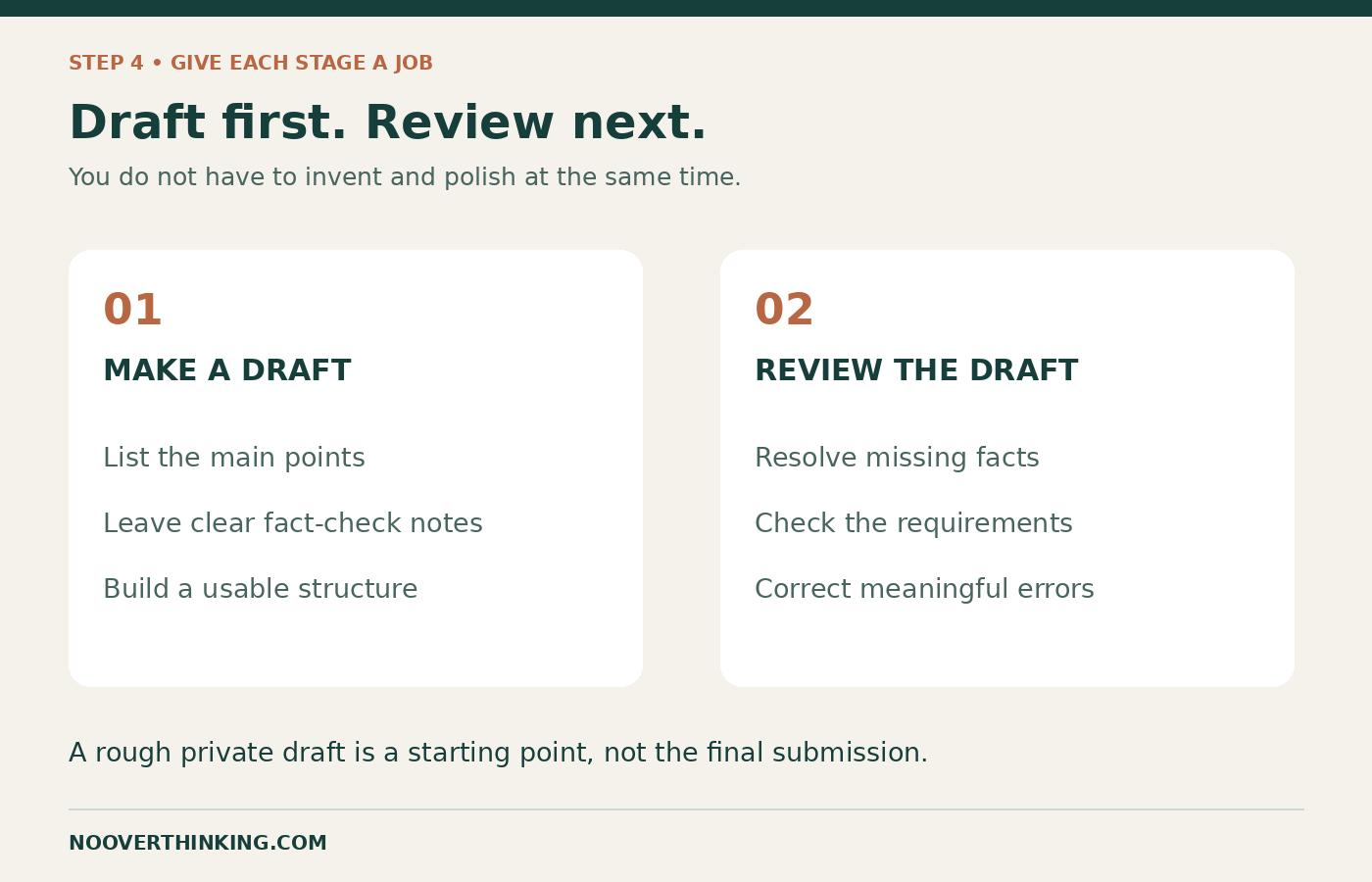
Choose a short period for producing material without polishing every line. For writing, use headings, fragments, or bullet points. For a presentation, sketch the order of slides. For tidying a room, gather items into broad groups before designing a perfect storage arrangement.
When an improvement occurs to you, make a brief note and keep moving. Use a clear marker such as “[check date]” for missing facts in a private draft. Resolve those markers before sharing a final version; permission to draft roughly is not permission to publish inaccuracies.
Then switch to a separate review period. Ask whether the draft meets the essentials you identified, and repair the gaps that matter. Separating these activities gives each a job. You do not have to invent, evaluate, and finalize the same sentence at the same instant.
5. Put a boundary around research and checking
Before opening another tab, name the question it will answer. “I need the submission deadline” has a stopping point. “I need to know everything about this subject” does not. If new information would not change your next action, consider closing the search and using what you already have.
Match your review to the consequences of an error. A routine scheduling message might need a check of the recipient, date, and request. A technical or safety-critical document may require a formal review process. Keep that process; do not replace it with an arbitrary timer.
Repeatedly asking other people whether ordinary work is “definitely okay” can also take the place of finishing. Request specific feedback when it is needed. If checking for reassurance has become the main activity, our guide to reassurance seeking explores that pattern in more detail.
6. Practice finishing one small, imperfect task
Choose an experiment with a limited downside. You might send a straightforward meeting confirmation after checking its essential details, even though you could still improve the phrasing. You are practicing letting a useful message be useful without requiring it to be your best writing.
Before you act, write down the prediction: “They will think I did not care if the wording is plain.” Afterward, record what actually happened. Keep observation separate from interpretation. No reply is not proof of approval or disapproval; it may simply mean there is no new information.
Experiments with perfectionism and procrastination should stay small and relevant. Do not deliberately create important mistakes to prove you can tolerate them. Practice dropping optional polish while preserving the requirements that protect other people and make the work dependable.
7. Review the process without turning it into a verdict
After the task, ask three questions: What helped me begin? Where did I add an unnecessary requirement? What would make the next attempt easier? Keep the answers brief enough that the review does not become another project.
If the task took longer than planned, inspect the estimate. Perhaps you had to locate a document, learn a missing skill, or handle interruptions. Adjust the plan using that information. “I should have done everything faster” gives you less guidance than identifying the actual bottleneck.
Notice useful behavior as well as the result: you asked for clarification, produced a draft, or stopped after the agreed review. Progress with perfectionism and procrastination may look like returning sooner after getting stuck, even when the task still feels uncomfortable.
Everyday examples: what to do instead of delaying
A work email you keep rewriting
The situation: a colleague needs an update, but you keep adjusting the tone. Your workable finish could be four sentences: the current status, the reason for a delay if relevant, the next step, and when they can expect another update.
Draft those four points first. Check the facts and recipient, then send the message when it meets the actual purpose. If there is a genuine disagreement or sensitive issue, use the extra care the situation requires. The exercise is about unnecessary polish, not ignoring context.
An assignment with too much research and no draft
The situation: your notes are growing, but the page is empty. Read the assignment requirements and sketch a section for each question you must answer. Place your existing evidence under those headings, then identify the specific gaps.
Research one gap at a time. A rough outline may show that you need one missing source, not another evening of general reading. Keep citation and originality requirements intact. Finishing sooner does not justify unsupported claims or copying someone else’s work.
A household task that has become an all-day project
The situation: you avoid clearing a desk because the entire room needs reorganizing. Define today’s task as making enough space to use the desk. Put rubbish in the bin, return obvious items, and gather uncertain items in one temporary place.
Schedule a separate decision about the remaining items if needed. You do not need the ideal storage system before you can have a usable surface. This example separates a practical need from the larger improvement you might choose to make later.
A worksheet for perfectionism and procrastination
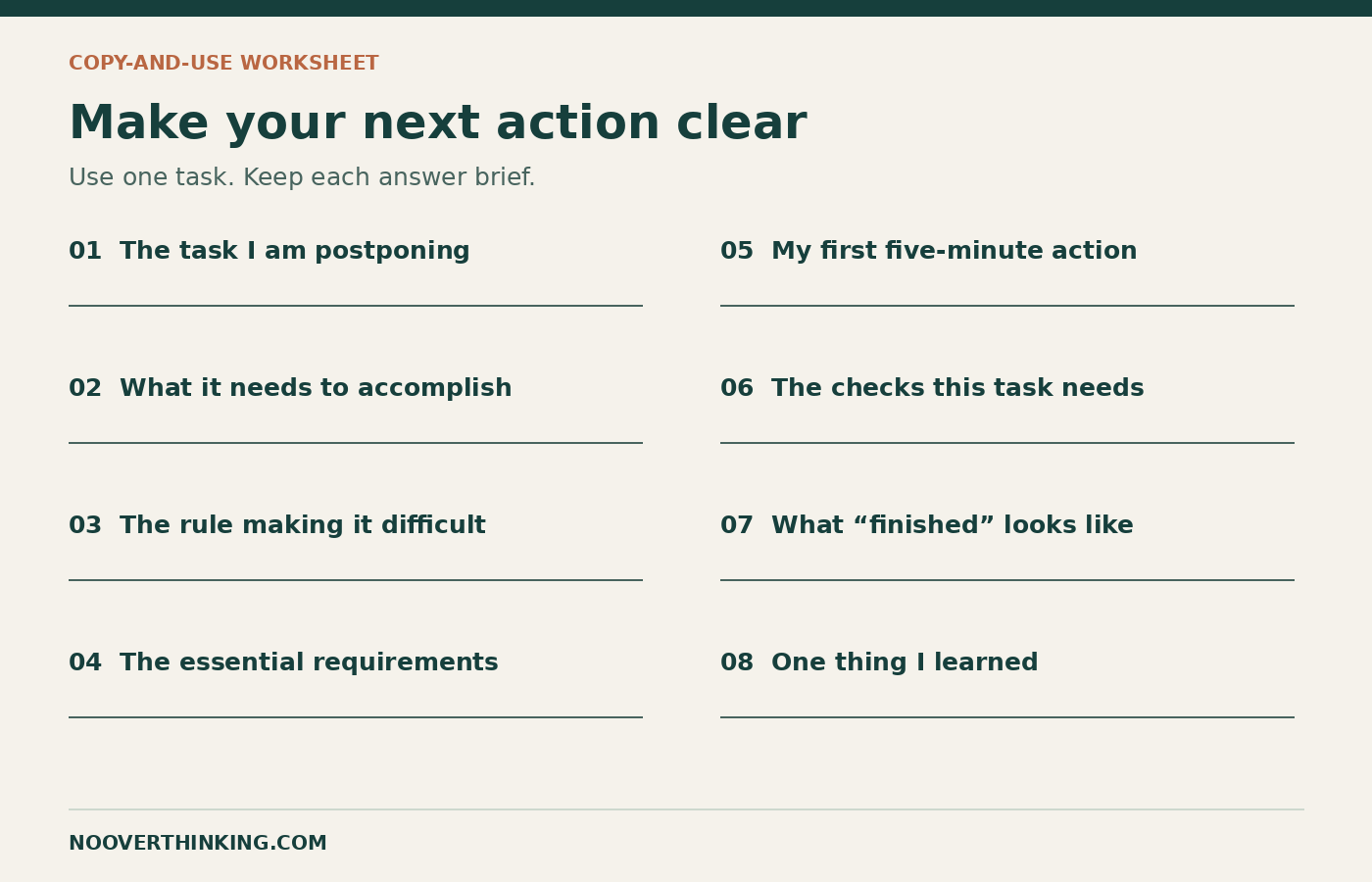
Copy these prompts into a note and use them for one task. Keep the answers short. The worksheet is a starting aid, so stop filling it out once you know what to do. You do not need a beautifully organized record of every attempt.
- Task: What specifically am I postponing?
- Purpose: What should this task help someone do or understand?
- Rule: What am I demanding before I will start or finish?
- Essentials: Which two or three requirements genuinely matter?
- First action: What can I physically do in the next five minutes?
- Review: Which checks are appropriate for this task?
- Finish: What visible result will tell me this attempt is complete?
- Learning: What happened, and what will I adjust next time?
For example: “I am postponing a meeting agenda. Its purpose is to help three people prepare. My rule says it must answer every question in advance. The essentials are the topics, the decisions needed, and the document links. My first action is to list the topics. I will check the links and send it.”
You can use the same worksheet when perfectionism and procrastination show up in a different setting. Change the requirements to fit the task rather than repeating one fixed standard everywhere. A birthday message, an application, and a formal report need different amounts of preparation.
What if you are still stuck?
If a small step still feels impossible, make it more specific or ask what is missing. You might need an example, a decision from a manager, a quieter setting, or rest. “Try harder” is not a substitute for a resource the task actually requires.
If your plan keeps expanding, return to the agreed essentials. Write new ideas in a separate list rather than adding them automatically. You can decide later whether they belong in a second version, another project, or nowhere at all.
If you finish but cannot stop mentally reviewing the work, write down any real follow-up once. Then choose the next activity in your day. Our guide to stopping work thoughts after work offers ideas for that transition.
If perfectionism and procrastination repeatedly disrupt your work, studies, relationships, or daily care, consider discussing the pattern with a qualified mental health professional. Support can help you understand what is maintaining the difficulty. Self-help suggestions should not become another standard you feel you must meet alone.
Frequently asked questions
Does perfectionism always cause procrastination?
No. Perfectionism and procrastination can occur together, but neither explains every instance of the other. Some people respond to high standards by working excessively rather than delaying. Some delay because instructions, time, energy, or support are missing. Look at the situation before choosing a strategy.
How can I keep high standards without getting stuck?
Make standards specific, proportionate, and connected to the task’s purpose. “Use accurate figures and explain the recommendation” is workable. “Create something nobody could question” is not. Keep essential checks and allow optional improvements to remain optional when the work already meets its requirements.
What if I really do perform better near a deadline?
A deadline can give a task a clear boundary, but it also leaves less room for corrections or unexpected problems. Try a small earlier milestone, such as an outline or first draft. Compare the experience using actual outcomes, rather than assuming pressure is the only way you can begin.
How long does it take to change this pattern?
There is no reliable timetable that fits everyone. Start with one repeatable task and observe several attempts. Look for earlier starts, fewer unnecessary revisions, or an easier return after a delay. If the pattern remains distressing or disruptive, seek support rather than setting a deadline for becoming perfectly productive.
Choose one task and make a workable start
You do not need to solve perfectionism and procrastination across your entire life today. Pick one ordinary task. Name its purpose, write down the essentials, and choose a small first action. Give that action a brief, realistic place in your day.
When you finish, leave yourself one useful observation instead of a score for your worth. The aim is dependable progress: work that serves its purpose, room to learn from feedback, and permission to move on when the necessary work is done.