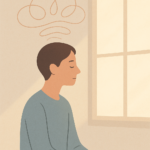

If you are wondering How to Stop Racing Thoughts at Night, you are not alone. Many people feel reasonably steady during the day, then suddenly become overwhelmed by worries, memories, unfinished tasks, and what-if thoughts the moment their head hits the pillow. Nighttime can make thoughts feel louder because there are fewer distractions, your body is tired, and your brain may finally have space to process the day. The good news is that you do not have to force your mind into silence. You can learn practical ways to calm your nervous system, relate differently to your thoughts, and make sleep feel less like a battle.
Why Racing Thoughts Feel Worse at Night
Racing thoughts at night often happen when the brain is trying to protect you, plan ahead, solve problems, or review experiences. During the day, work, conversations, screens, errands, and responsibilities keep your attention moving. At night, when the room is quiet, the mind may bring forward everything it did not fully process earlier.
This does not mean something is wrong with you. It means your brain is active, alert, and sometimes overprotective. Stress, anxiety, caffeine, late-night screen time, unresolved conflict, major life changes, and irregular sleep patterns can all contribute to a busy mind at bedtime. If your thoughts are intense, persistent, or connected with panic, trauma, depression, or thoughts of harming yourself, it is important to reach out to a licensed mental health professional or a crisis resource in your area. Support is available, and you do not have to handle it alone.
For a deeper explanation of what racing thoughts are and why they happen, you may find this guide helpful: what racing thoughts can mean.
How to Stop Racing Thoughts at Night: Start by Understanding the Pattern
The first step in How to Stop Racing Thoughts at Night is noticing the pattern without immediately judging it. Racing thoughts often grow stronger when you treat them like an emergency. If you think, I must stop thinking right now or I will never sleep, your body may become more alert. That alertness can keep the cycle going.
Instead, try approaching your thoughts with curiosity. Ask yourself: What kind of thoughts are showing up? Are they about tomorrow, the past, relationships, health, money, mistakes, or uncertainty? Are they practical problems that need a plan, or mental loops that keep repeating without resolution?
This distinction matters. Some thoughts need a small action, like writing down a reminder. Others need a different response, such as grounding, self-compassion, or acceptance. The goal is not to win an argument with your mind. The goal is to lower the intensity so your body can move toward rest.
9 Practical Ways to Calm Racing Thoughts Before Sleep
These strategies are simple, evidence-informed, and realistic. You do not need to do all of them perfectly. Pick one or two to start, practice them for several nights, and adjust based on what helps your body feel safer and calmer.
1. Do a 10-Minute Brain Dump Earlier in the Evening
If you want to know How to Stop Racing Thoughts at Night, one of the most useful habits is to give your thoughts a place to go before bedtime. A brain dump is a short writing exercise where you put everything on paper without trying to organize it perfectly.
Set a timer for 10 minutes and write down:
- Tasks you need to remember
- Worries that keep repeating
- Conversations you are replaying
- Things you are afraid you might forget
- Questions you do not need to answer tonight
Then, next to any practical item, write one tiny next step. For example, instead of writing, Figure out finances, write, Check account balance tomorrow at lunch. This tells your brain, This has been captured. We do not need to solve it at 1 a.m.
2. Create a Worry Window During the Day
A worry window is a scheduled time, often 10 to 20 minutes, when you allow yourself to think through concerns intentionally. This may sound strange, but postponing worry until a planned time can reduce the feeling that worries must be handled immediately at night.
Try this: Choose a consistent time, such as 5:30 p.m. During that window, write your worries, separate solvable problems from unsolvable uncertainties, and choose one useful action. When worries show up at bedtime, gently remind yourself, I have a time for this tomorrow. Right now is rest time.
This technique is especially useful if your nighttime thoughts are repetitive rather than productive. If you want additional strategies for daytime and evening rumination, this article on how to stop racing thoughts offers practical tools you can use outside of bedtime too.
3. Calm Your Body Before You Challenge Your Thoughts
A helpful answer to How to Stop Racing Thoughts at Night is to start with the body, not the mind. When your nervous system is activated, logical self-talk may not work very well. Your brain is more likely to believe anxious thoughts when your heart is racing, your muscles are tense, or your breathing is shallow.
Try a simple breathing pattern:
- Inhale slowly through your nose for 4 seconds.
- Exhale gently for 6 seconds.
- Repeat for 3 to 5 minutes.
- Let your shoulders drop slightly with each exhale.
Longer exhales can send a signal of safety to the body. You do not have to breathe perfectly. The aim is not to force relaxation, but to give your system a steady rhythm to follow.
4. Use a Grounding Exercise When Thoughts Spiral
Grounding brings your attention back to the present moment. This helps when your mind is jumping between future fears and past regrets. A simple option is the 5-4-3-2-1 method.
While lying in bed or sitting somewhere comfortable, name:
- 5 things you can see
- 4 things you can feel
- 3 things you can hear
- 2 things you can smell
- 1 thing you can taste or one slow breath you can notice
For example, you might notice the outline of your dresser, the blanket on your legs, the hum of a fan, the scent of laundry detergent, and the feeling of your breath. This gives your brain a concrete task that is not problem-solving.
5. Stop Trying to Force Sleep
This is one reason How to Stop Racing Thoughts at Night can feel counterintuitive: trying harder to sleep often makes sleep feel more difficult. When you lie there monitoring the clock and checking whether you are asleep yet, your brain stays engaged.
If you have been awake for a while and feel increasingly frustrated, consider getting out of bed briefly. Keep the lights low and do something quiet, such as reading a calming book, listening to soft audio, stretching gently, or sitting with a warm drink without caffeine. Return to bed when you feel sleepy again.
This helps your brain associate bed with rest rather than mental struggle. It is not about giving up on sleep. It is about reducing pressure so sleep has more room to happen naturally.
6. Use a Kind Response to Repetitive Thoughts
Many people respond to racing thoughts with criticism: Why am I like this? I should be over this. I am ruining tomorrow. Unfortunately, harsh self-talk can make the mind feel even less safe.
Try replacing criticism with a calm, compassionate phrase:
- This is a worry loop, not an emergency.
- I can think about this tomorrow with more energy.
- My mind is trying to protect me, but I am allowed to rest.
- I do not have to solve every thought tonight.
The words matter less than the tone. Imagine speaking to a friend who is exhausted and overwhelmed. That is the tone your mind needs at night.
7. Practice Cognitive Defusion
When practicing How to Stop Racing Thoughts at Night, it helps to remember that a thought is not the same as a fact. Cognitive defusion is a skill used in acceptance-based therapies that helps you create space between yourself and your thoughts.
Instead of saying, Tomorrow will be a disaster, try saying, I am having the thought that tomorrow will be a disaster. Instead of I cannot handle this, try My mind is telling me I cannot handle this.
This small wording change can reduce the power of the thought. You are not arguing with it or pretending it is not there. You are simply noticing it as mental activity. For intrusive or unwanted thoughts that feel sticky, you may also find this guide useful: how to stop intrusive thoughts without fighting your mind.
8. Reduce Common Nighttime Triggers
Sometimes racing thoughts are intensified by habits that keep the brain alert. Small changes can make a meaningful difference over time.
Consider adjusting these common triggers:
- Caffeine: Try avoiding caffeine in the afternoon or evening, especially if you are sensitive to it.
- Alcohol: Alcohol may make you sleepy at first but can disrupt sleep quality later in the night.
- Scrolling: Social media, news, and work messages can activate comparison, worry, or problem-solving.
- Late work: If possible, create a buffer between productivity mode and sleep mode.
- Irregular sleep times: A consistent schedule helps your body predict when it is time to wind down.
Stress can strongly affect sleep and mental activity. The American Psychological Association offers helpful information about stress and how it affects the body and mind.
9. Build a Wind-Down Routine Your Brain Can Recognize
Your brain loves cues. If every night looks different, it may not know when to shift out of alert mode. A wind-down routine does not have to be complicated. In fact, the simpler it is, the more likely you are to repeat it.
Here is an example of a 30-minute routine:
- Turn off work-related notifications.
- Dim the lights.
- Write a short brain dump or tomorrow list.
- Wash your face or take a warm shower.
- Stretch for 5 minutes.
- Read something calming in bed.
- Use slow breathing once the lights are off.
The routine becomes a signal: the day is ending, and you are safe enough to rest. If nighttime overthinking is a familiar pattern for you, this related article on overthinking at night may help you build a broader plan for calmer evenings.
A Simple Routine for How to Stop Racing Thoughts at Night
Think of How to Stop Racing Thoughts at Night as a 24-hour process, not just something you do after midnight. Your brain is influenced by how you spend the entire day: how much stress builds up, whether you take breaks, how you handle emotions, and how you transition into rest.
Morning: Give Your Day a Clear Starting Point
In the morning, write down your top three priorities. This reduces the chance that your brain will start sorting through everything at bedtime. Keep it realistic. A clear day does not need to be a perfect day.
Afternoon: Release Some Mental Pressure
Take a short pause during the afternoon. Step outside, stretch, breathe, or write down any worries that are building. This helps prevent emotional pressure from accumulating until bedtime.
Evening: Close the Day Intentionally
Your plan for How to Stop Racing Thoughts at Night should include a clear closing ritual. You might review what you completed, write what can wait, and choose one comforting activity that does not involve intense stimulation.
Middle of the Night: Keep It Gentle and Boring
The middle of the night version of How to Stop Racing Thoughts at Night should be simple. Do not start a major life review. Do not open stressful emails. Do not try to solve every problem. Use a grounding exercise, repeat a compassionate phrase, or briefly get out of bed for a quiet reset if needed.
What Not to Do When Your Mind Is Racing
Learning How to Stop Racing Thoughts at Night also means knowing which responses can accidentally keep the cycle going. These habits are understandable, but they often make the mind more alert.
- Do not argue with every thought. Arguing can turn one thought into a long mental debate.
- Do not check the clock repeatedly. This can increase pressure and frustration.
- Do not search the internet for reassurance for hours. Reassurance can feel helpful briefly, but it may train the brain to keep seeking certainty.
- Do not punish yourself for being awake. Stressing about sleep usually makes rest harder.
- Do not make big decisions at 2 a.m. Most problems are easier to evaluate after rest.
A practical example: If you suddenly remember an awkward comment you made earlier, your mind may want to replay the entire conversation. Instead, say, This is a replay loop, write one sentence if needed, and return to your breath. You are not ignoring your life. You are choosing the right time to think clearly.
When Racing Thoughts May Need Extra Support
If How to Stop Racing Thoughts at Night has become a nightly struggle and it is affecting your work, relationships, mood, or ability to function, consider speaking with a mental health professional or healthcare provider. Racing thoughts can happen with stress, anxiety, grief, trauma, major life transitions, hormonal changes, medication effects, and other factors. A professional can help you understand what may be contributing and what support fits your situation.
If your racing thoughts come with intense fear, panic symptoms, or constant worry that feels hard to control, the National Institute of Mental Health has reliable information on anxiety disorders and treatment options. Reading information is not a diagnosis, but it can help you decide when to reach out for support.
You deserve help before things feel unbearable. Therapy, medical guidance, lifestyle adjustments, stress management, and sleep-focused interventions can all be part of a healthier plan depending on your needs.
FAQ
What is the fastest way to practice How to Stop Racing Thoughts at Night?
The fastest part of How to Stop Racing Thoughts at Night is usually calming the body first. Try slow breathing with a longer exhale, then write down any urgent reminders on paper. This reduces the need to keep mentally rehearsing everything.
Why do my thoughts race only when I try to sleep?
Nighttime removes distractions, so your brain may finally process stress, unfinished tasks, or emotions from the day. Fatigue can also make worries feel bigger. A consistent wind-down routine can help your mind transition more gently.
Should I stay in bed if I cannot sleep?
If you are relaxed, staying in bed may be fine. If you are becoming frustrated or alert, it can help to get up briefly and do something quiet in low light. Return to bed when you feel sleepy again.
Can learning How to Stop Racing Thoughts at Night help with anxiety?
It may help reduce nighttime worry and support better sleep, but it is not a substitute for professional care. If anxiety feels persistent, overwhelming, or disruptive, consider talking with a licensed therapist or healthcare provider.
Is it better to distract myself or face the thoughts?
It depends on the thought. Practical concerns may need a quick note or plan. Repetitive worry loops often respond better to grounding, breathing, compassion, and letting thoughts pass without engaging every detail.
Conclusion
Learning How to Stop Racing Thoughts at Night is not about forcing your mind to go blank. It is about creating enough safety, structure, and calm for your brain and body to let go of the day. Start small: write a brain dump, practice longer exhales, reduce late-night triggers, and respond to your thoughts with less urgency. Over time, these habits can make bedtime feel less like a mental battlefield and more like a gradual return to rest.
For more practical tools to calm overthinking and support your mental well-being, explore more helpful articles on NoOverthinking.